
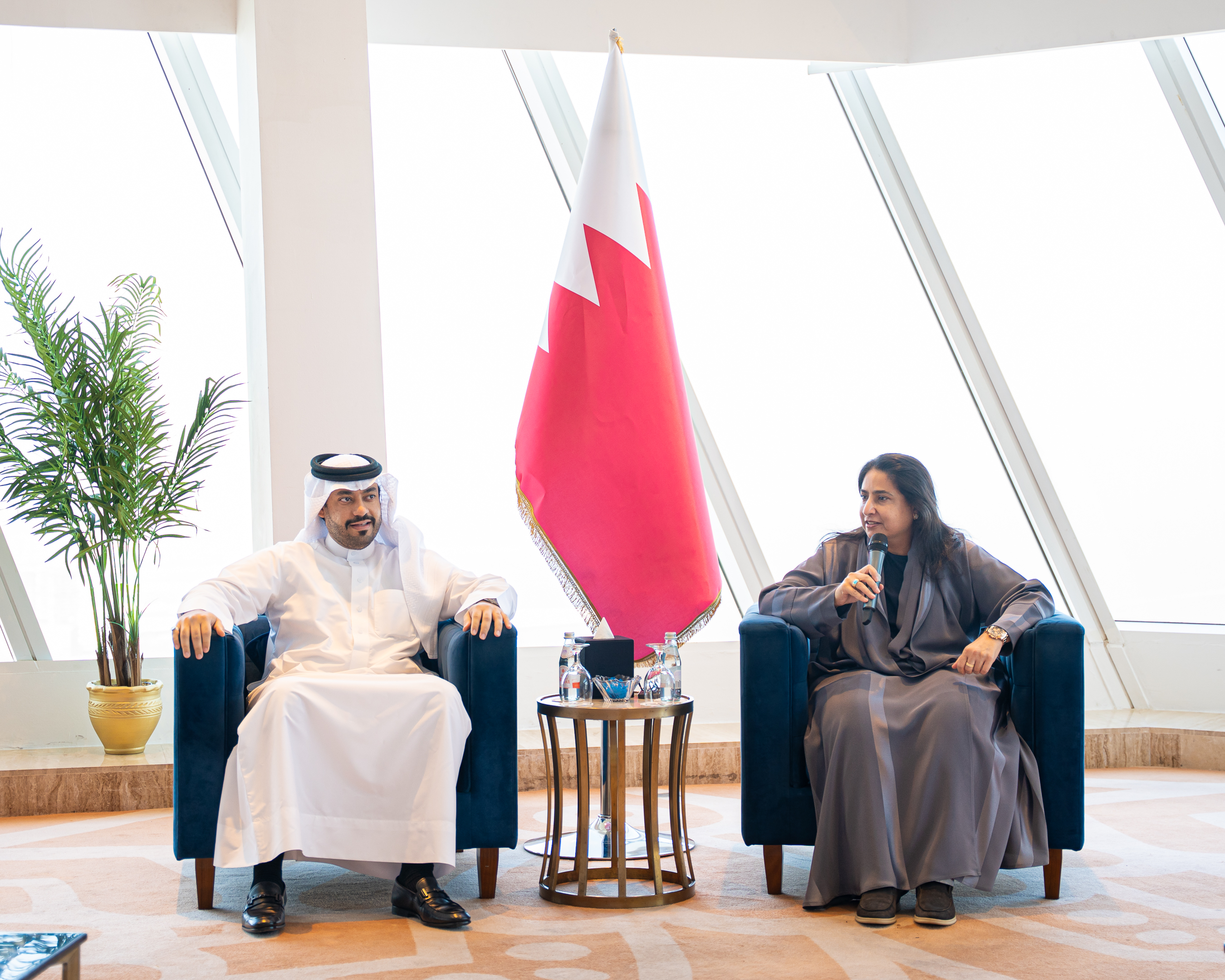
Dr. Shaikha Rana Bint Isa bin Duaij Al Khalifa, Director General of the Institute of Public Administration, affirmed that enhancing the effectiveness of government performance requires the adoption of best practices and the exchange of expertise among national leaders, in a manner that supports institutional integration and achieves the objectives of the National Program for the Development of Government Leadership. This, she noted, contributes to building a more impactful government communication system at both the local and international levels. She explained that empowering government leaders with communication, engagement, and media interaction skills is among the most important leadership competencies, as it significantly contributes to highlighting the Kingdom of Bahrain’s efforts, achievements, and development projects across various platforms.
This was stated during a dialogue session organized by the Institute of Public Administration, attended by the Director General of the Institute and Mr. Ahmed Khaled Al Arifi, Chief Executive of the National Contact Center, with participants of the 36th cohort of the Executive Leadership Development Program “Qiyadat,” which is delivered by the Institute to public sector directors as part of the National Program for the Development of Government Leadership.
The Director General noted that integrating the communication and influence axis within the “Qiyadat” program comes in response to the requirements of the current and upcoming phases. Communication, she emphasized, is no longer merely a media tool, but has become a strategic means to support public policies, enhance transparency and professionalism, and unify communication messages in line with digital transformations and a comprehensive national vision. She affirmed the Institute’s commitment to keeping pace with developments in government communication by adopting innovative training approaches, such as simulation and practical application, to prepare leaders capable of effectively managing media messages in support of national objectives and societal expectations.
For his part, Mr. Ahmed Khaled Al Arifi, Chief Executive of the National Contact Center, emphasized that establishing an effective government narrative requires sustained investment in developing professionals in the communication sector. This contributes to keeping pace with best practices, enhancing the efficiency of communication messages, and strengthening a media presence that reflects the government’s vision and aspirations at both the local and international levels.
Al Arifi added that government communication today represents a key pillar in building societal awareness of government initiatives, projects, and services. Communication, he noted, is no longer limited to media coverage, but has assumed a vital role in conveying institutional content in an effective and impactful manner that reflects national achievements and responsibly and transparently meets the aspirations of society.
In this context, Al Arifi pointed to the launch of the Executive Program in Government Communication, implemented through cooperation between the National Contact Center and the Institute of Public Administration. The program embodies a commitment to achieving sustainability in capacity building and empowerment, enabling participants to lead communication initiatives efficiently amid a fast-evolving media landscape and complex challenges that require clear messaging and precise analytical insight. He stressed that the coming phase calls for the adoption of more comprehensive and advanced communication models, based on clear performance indicators, that contribute to building a positive and realistic image of the Kingdom of Bahrain and reflect its achievements within the framework of comprehensive national development.
Last Updated on 2 February 2026